Rep. Marsh Is Wrong About the Threat to Rural Jackson and Josephine County,” pulled straight from his own opening sentence.
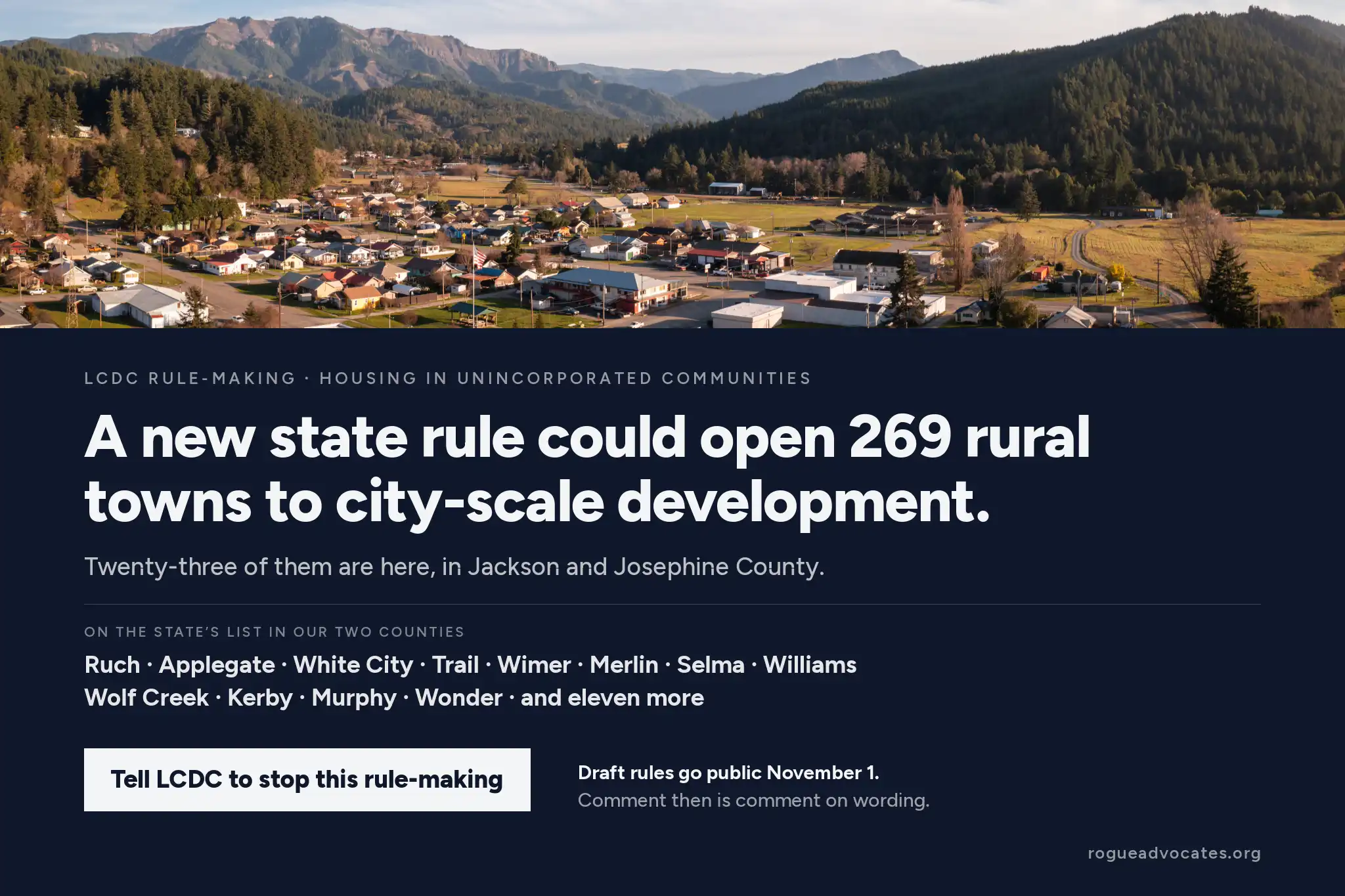
State Representative Pam Marsh (D-Ashland) is wrong that LCDC’s rule-making does not pose a real threat to rural Jackson and Josephine County by allowing city-type residential, commercial and industrial development. But she is right about one thing, and it matters: all of us who oppose this have 96 more days to say so.
On Thursday, August 27, Rogue Advocates alerted residents to the threat to rural communities, lands and resources from rule-making by the Land Conservation and Development Commission (LCDC), and asked people to testify at the commission’s meeting on Friday, August 28.
Representative Pam Marsh (D-Ashland) commented:
This post is wrong. The work under consideration by the commission today is purely technical fixes to confirm rules to statute. Any rules drafted from the Rural Housing discussion will be posted for comment, probably not until the end of the year.
We know that, Rep. Marsh. It is exactly why we did what we did.
We were not asking for testimony on an item on LCDC’s agenda. We were testifying on an item that is not on their agenda. We gave our testimony during the general public comment period, Item 12, which the agenda reserves for “items not otherwise on the agenda.” That is a different item from Item 9, the farm and forest rule conforming amendments you were describing.
We urged people in Jackson and Josephine counties to testify, asking LCDC to terminate its “Housing in Unincorporated Communities Rule Making” (the “HUC”), and to testify now, before rules are drafted that would allow urban development across rural Oregon.
Rep. Marsh said: There is no current proposal to allow growth in the way described in this post.
We disagree, and here is why.
We are providing a link to the HUC staff report to LCDC in April and the charge to the HUC Rules Advisory Committee (RAC), so you can read for yourself the threat we are facing:
LCDC Agenda Item 5, April 23-24, 2026: Housing in Unincorporated Communities
Here are the key elements of that document.
LCDC’s tracking table of unincorporated communities, last revised in 2014 and republished as Attachment B to this April staff report, pages 9 through 21, lists 269 unincorporated communities in just 24 of Oregon’s 36 counties. The staff report says, in the department’s own words, that “the rulemaking scope addresses all unincorporated communities.”
The Jackson and Josephine County places named on that table include Ruch, Applegate, White City, Trail, Foots Creek, Savage Creek, Sams Valley, Lake Creek, Lincoln-Pinehurst, Prospect, Wimer, Merlin, North Valley, Kerby, Murphy, Selma, Williams, Wilderville, Wonder, Wolf Creek, Sunny Valley, O’Brien, Pottsville and Shan Creek.
There may be more in the other twelve counties the table does not cover.
It is not correct to say, as some people have, that the rule-making is limited to the seventeen “urban” unincorporated communities, particularly since those places are already exempted from most of the limitations on rural development. Of the 269 communities on the state’s list, only seventeen are urban unincorporated communities. LCDC’s own staff report says, on page 3, that “the rulemaking scope addresses all unincorporated communities.”
The purpose of the rule-making is to change state rules and policy to give counties the power to allow urban types of development in some or all of these hundreds of communities. The charge asks for rules allowing “more intense urban uses” and requiring counties to zone for “appropriate commercial and light industrial uses.” In practice that language reaches things like higher density subdivisions, multi-plexes, data centers, Amazon distribution centers, strip commercial development, short term rentals and so on.
Here are the key excerpts from LCDC’s charge to the Rules Advisory Committee (RAC), page 7 of that same PDF:
RAC members are charged to advise DLCD staff on revisions to Administrative Rules for LCDC consideration that:
• Minimize legal uncertainty and remove unnecessary regulatory barriers to county decisions to increase housing density or allow more intense urban uses in these areas;
• Require participating counties to plan and zone for community needs to support these areas, including but not limited to appropriate commercial and light industrial uses, transportation, public safety, public facilities and urban services;
• Allow counties to expand the boundaries of these communities where appropriate to provide improved housing opportunities while continuing to minimize impacts to natural resources and working lands;
Rep. Marsh got one thing right that we got wrong. This will not be the last chance to comment. But look at what the remaining chances are. In December you will have three minutes, and possibly only two, at a time that is not fixed in advance, after the draft rule has already been written. You can also write an email. That is not the same as being heard while the rule is still being shaped.
So yes, Rep. Marsh is correct. August 28 was not the last time to testify.
But the rule-making was not on the agenda at all, because LCDC’s schedule does not call for public comment until a draft of the rule is finished.
No provision was made for public comment at the first Rules Advisory Committee meeting on August 19, and none appears on the schedule for the meetings on September 11 and October 12. It is not clear the RAC will ever take public testimony.
DLCD says it expects to publish draft rules for public comment on November 1. So our official written comment time comes after a draft has already been written. It is a chance to comment on the cake once it is already in the oven.
LCDC’s remaining meetings this year are October 22 and 23, and December 3 and 4. At each of those you will get three minutes to speak your piece, though the agenda says the Chair can cut that to two minutes or one minute depending on how many people show up.
Allow a full day for testimony, because LCDC’s agendas say plainly that “times listed are approximations” and items can be taken up earlier or later than noted. At the August 28 meeting one person drove several hours from the Coast to Salem, learned while driving that the time for testimony had moved up by more than an hour, and turned around and drove home.
In other words, rather than waiting until it is too late, we need to start speaking up now, and keep asking all our elected officials to tell LCDC to stop this rule-making rather than wait for the draft rules to be written.
The bigger picture: well-funded and politically well-connected private interests are pressing on the laws that have kept Oregon lovable and livable, in the name of a kind of prosperity built on Texas-style real estate development.
This rule-making is part of a wide-ranging and continuing effort against the laws that stopped Oregon from turning into California and Texas. Other threats to rural Oregon are coming from the Oregon Legislature.
Rogue Advocates calls on Rep. Marsh to join us in turning back these threats, at LCDC and in the Legislature: threats to farm, ranch and forestlands, to our water and wildlife, to lives and property at risk from fires and floods, and to taxpayers.
Join us in this fight to keep Oregon livable, lovable and affordable, and to save the Oregon Way.
There is more coming over the next few weeks:
- What Oregonians across the state said about LCDC’s rule-making.
- LCDC’s failure to show any need for the rule-making.
- The problems with how LCDC’s Rules Advisory Committee appointments were made.
Everything above is Robert’s. What follows is reference material we added.
What you can do now
| Write the commission | Written comment is accepted at any time, and DLCD says comments sent before the comment period opens “will be reviewed by staff to inform the draft rules.” Denise Johnson, Commission Assistant: denise.johnson@dlcd.oregon.gov |
| Get the notices | DLCD announces the comment period only to its email subscribers. Sign up: public.govdelivery.com/accounts/ORDLCD |
| Testify in person or by Zoom | LCDC meets October 22-23 and December 3-4. Sign up at oregon.gov/LCD/Commission/Pages/Public-Comment.aspx |
| Watch the committee | Rules Advisory Committee meetings September 11 and October 12, livestreamed on DLCD’s YouTube channel |
| Talk to your county | The rule-making gives counties a voluntary option. Ask your commissioners to say they will not use it. |
The documents behind this post
- LCDC staff report and charge, Agenda Item 5, April 23-24, 2026, the scope statement is on page 3, the adopted charge on page 7, and the 2014 tracking table of unincorporated communities on pages 9 through 21.
- DLCD rule-making page, Housing in Unincorporated Communities, the committee roster, meeting packets, and the November 1 comment date.
- LCDC commission meetings, agendas and materials for October and December.
Every quotation in this post is verbatim and every page number can be checked in the linked PDF.
Related Stories
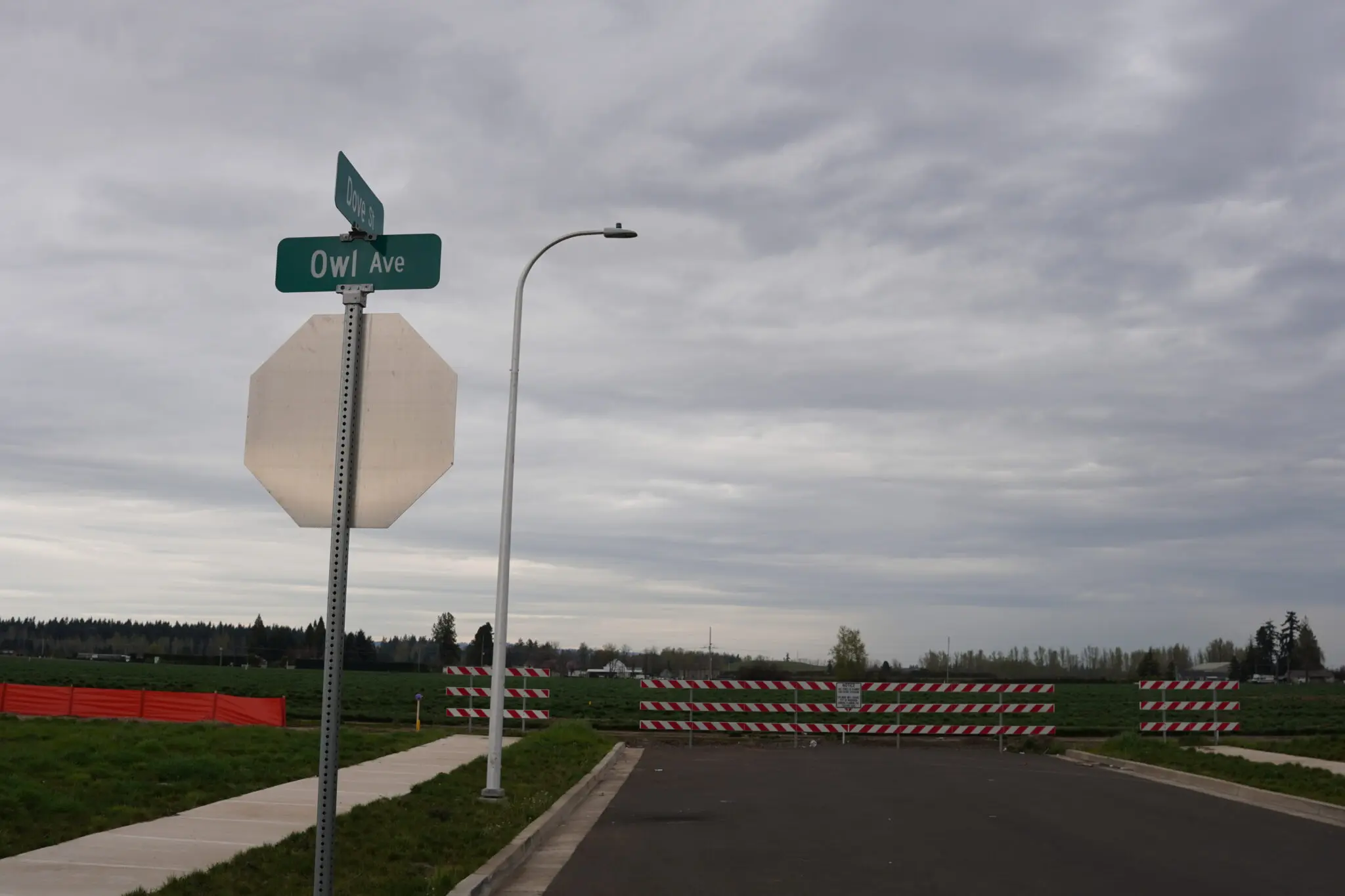
Holding the Line, Building the Future: The Rogue Valley’s Stake in Oregon’s UGB Debate
A street ends at an empty field at the edge of Woodburn’s urban growth boundary. This empty field is now the potential site of a new housing development, a possibility with House Bill 4035. (Photo by Robin Linares/Oregon Capital Chronicle)
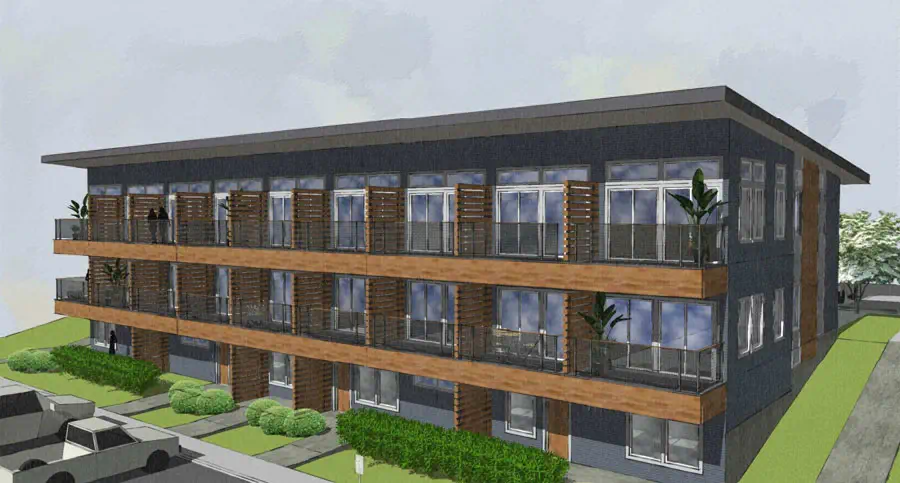
Grand Terrace Apartments: From Opposition to Advocacy in Ashland
The Grand Terrace Apartments project is back before the Ashland City Council, and approval now seems likely. Rogue Advocates originally opposed the proposal, but our persistence helped bring meaningful improvements, including fire-resistant, solar-powered buildings and fairer affordable housing standards. This project is a reminder that strong community advocacy can shape development for the better.
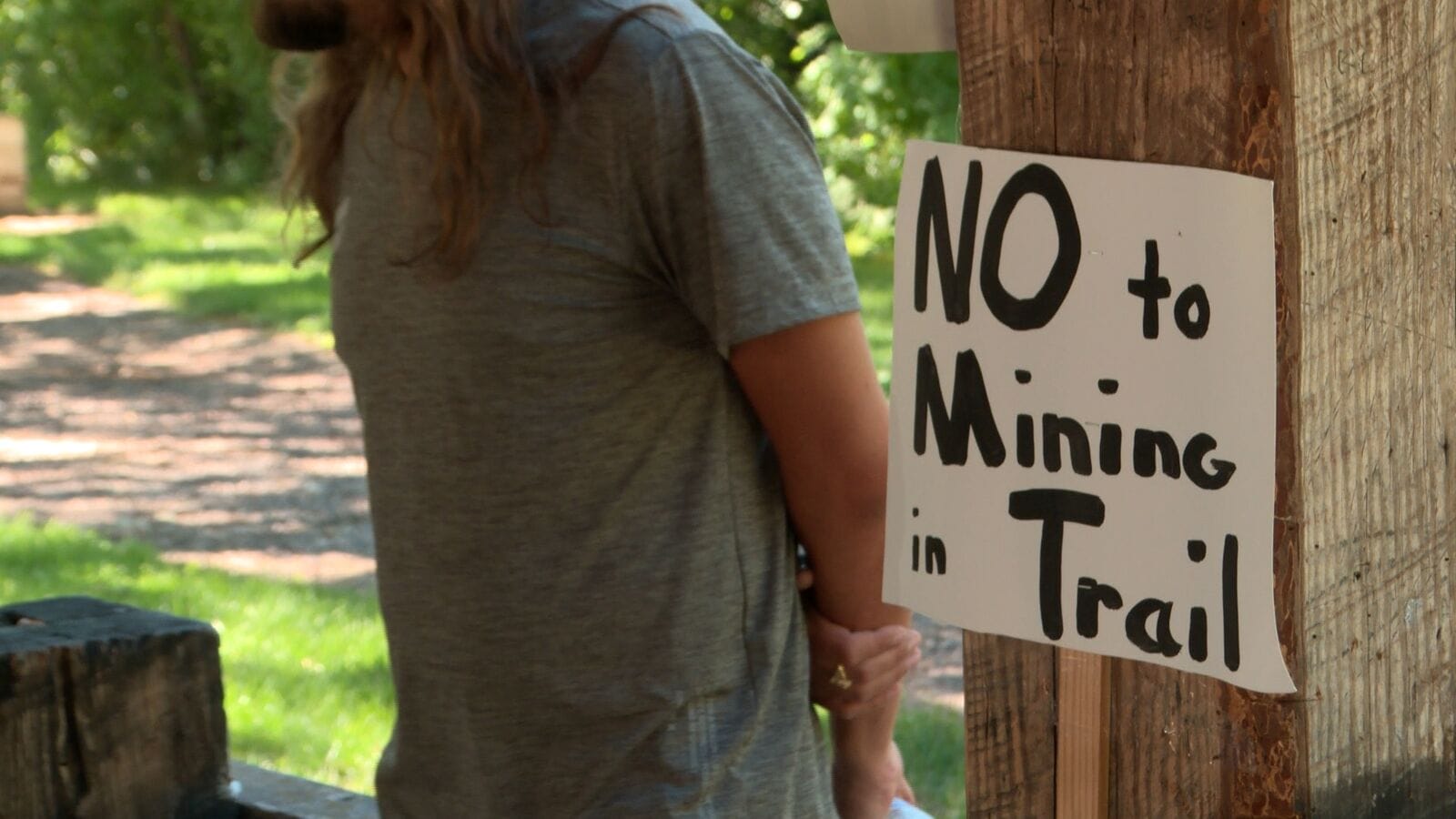
Jackson County denies proposal for 64-acre aggregate mine
Facing sustained opposition from Rogue Advocates and community members, Jackson County made its final decision to deny an application for an aggregate mining operation on nearly 64 acres a few miles north of Shady Cove on Highway 227. The application was seeking approval for mining, crushing, sizing, stockpiling, hauling, and blasting, all within close proximity […]