Floating Solar on a Rogue Valley Reservoir: Oregon’s First, and What It Means
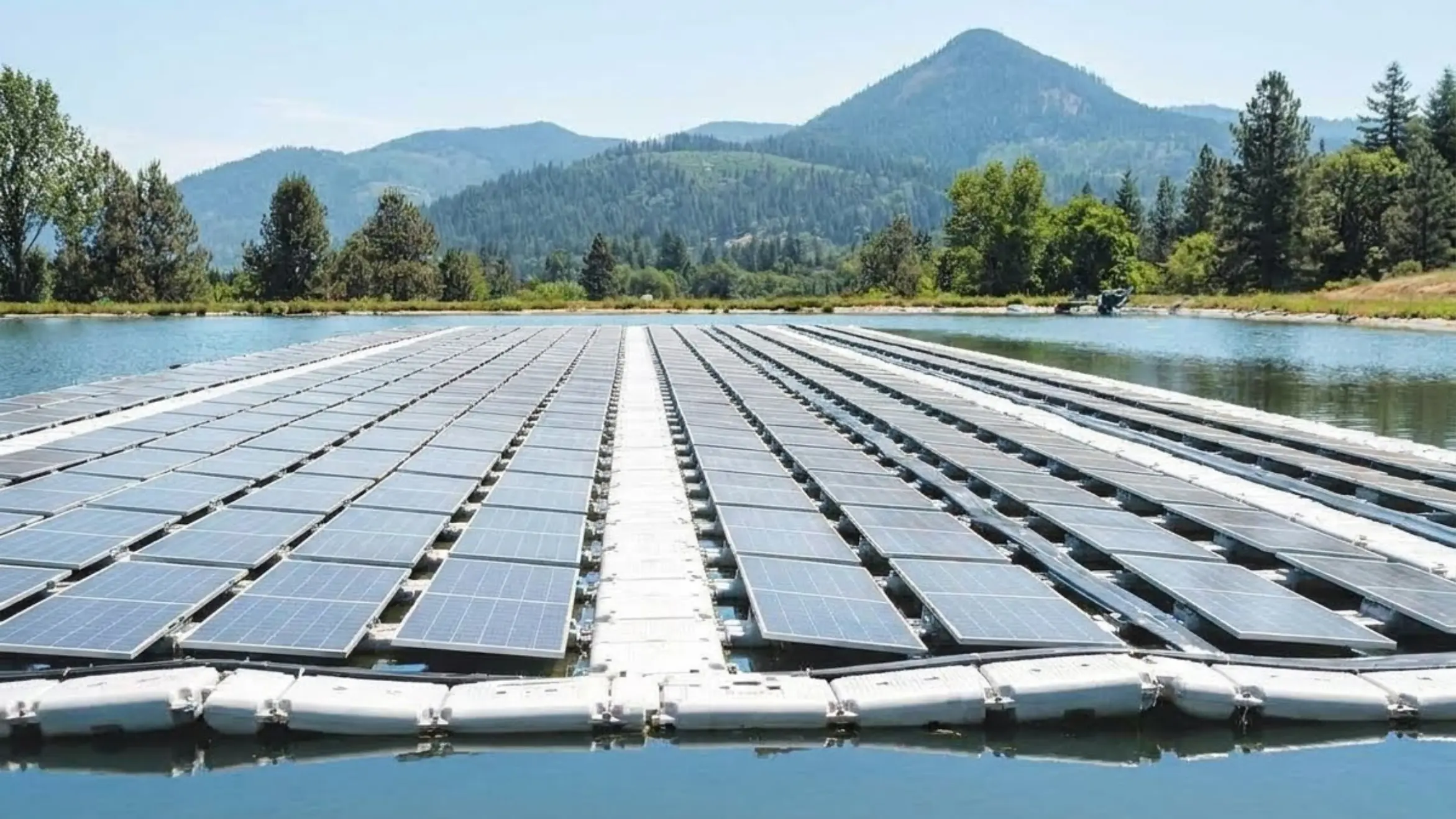
On a clear morning in early May, U.S. Senator Jeff Merkley stood at the edge of a Medford Irrigation District reservoir in Central Point and watched the sun hit 1,776 solar panels. Not on a roof, not on a fence-line in the high desert, but floating on water that’s been pushing through Rogue Valley irrigation ditches since the 1850s.
Oregon’s first floating solar array is now generating power.
It’s small. By utility-scale standards, almost embarrassingly so. At 800 kilowatts on a reregulation reservoir, the $3.8 million array will produce roughly 2 million kilowatt-hours of electricity per year and bring in around $76,000 annually to support MID operations. Meaningful for an irrigation district’s budget, modest for the grid. Sunstone Solar, the massive eastern Oregon project breaking ground this year, is more than two thousand times its size.
But size is the wrong lens for what’s happening on this reservoir.
A 170-year argument, finally settled
The Rogue Valley’s irrigation history starts in 1852, one year after the gold strikes that pulled the first settlers up the Bear Creek drainage. They saw what the Takelma had long known: this is a place where water and sun together can grow almost anything, but only if you can hold onto the water through the dry months.
Every generation since has improved on the system. Hand-dug ditches became flumes. Flumes became concrete-lined canals. Wood headgates became steel ones. Manual schedules became automated dispatch.
The floating solar array is the next move in that 170-year argument with the climate. Cover 1.8 acres of an existing reservoir with photovoltaic panels and three things happen at once: you generate clean electricity on infrastructure you already own, you cut evaporation off the water surface, and you slow the algae and aquatic weeds that fight your delivery system every summer. The Medford Irrigation District serves about 12,000 acres of Jackson County farmland. Pears, vineyards, hay, vegetables, pasture. Anything that helps water arrive in better condition and in larger quantities matters to every one of those operations.
This is what dual-use infrastructure actually looks like. Not a press-release abstraction. Real water. Real panels. Real bills coming down.
Energy equity, built into the design
The array operates under the Oregon Community Solar Program, which means the electrons don’t disappear into the grid as a wholesale commodity. They show up as bill credits for households and businesses who subscribe. Half the project’s output is allocated to Jackson County residents and half to local businesses, with subscribers seeing up to a 50% reduction on their electric utility bills.
Ten percent of the project’s total output is reserved for income-qualified households, enough to power roughly 20 low-income homes with a guaranteed 50% bill credit and exemption from administration and project manager fees. Those protections don’t exist for retail rooftop solar at any price point.
That’s the part that’s easy to lose in the technical fact sheet. A Jackson County family that can’t put panels on their roof, whether because they rent, live in an apartment, can’t manage the upfront cost, or have trees shading the lot, can now subscribe to a piece of a reservoir-top solar array and watch their power bill drop. That’s not a future scenario. It’s available now.
The legislative window is open, briefly
Three bills passed by the 2026 Oregon Legislature shape what comes next:
HB 4031 lets renewable energy developers take qualifying projects directly to county-level permitting instead of the Energy Facility Siting Council, provided they’re racing the federal tax credit deadlines created by H.R. 1. It’s a temporary off-ramp from a process that can take years, and it was passed specifically because the EFSC bottleneck threatened to leave shovel-ready clean energy projects on the table.
HB 4029, Oregon’s first solar consumer protection statute, takes effect June 5, 2026. It requires plain-language disclosures, written savings estimates that actually reflect local utility rates, and approved interconnection agreements before installers begin work. Southern Oregon saw a wave of fly-by-night solar companies between 2022 and 2024, many of them gone within months of pocketing deposits. HB 4029 is the legislative answer to that.
HB 4076 makes it easier to grant land use exceptions for new energy projects that can plug into existing interconnection infrastructure near other projects, with mitigation plans required for impacts on neighboring farm operations.
For irrigation districts in Jackson and Josephine counties watching MID’s pilot, the message is clear: the permitting environment in Oregon will probably never be more favorable than it is for the next three years.
Why this scales beyond one reservoir
The Rogue Basin Water Users Council exists because the Rogue River Valley Irrigation District, Talent Irrigation District, and MID have been cooperating on water management for decades. They share watersheds, they share infrastructure, they share an ESA Section 7 consultation, and they share the same long summers.
If the MID floating array delivers on its operational promises, and the early returns from comparable installations around the world suggest it will, there is no reason RRVID and TID couldn’t follow with their own arrays on their own reregulation reservoirs. The capital is the bottleneck, not the engineering. And the Oregon Community Solar Program, combined with HB 4031’s expedited siting, makes that capital more accessible than it has been at any point in the program’s history.
This is the part worth taking seriously. The 800-kilowatt pilot is not the point. The point is the proof that the model works in our climate, on our infrastructure, with our regulatory framework. Once that’s established, replication is a financing question, not an engineering one.
Questions worth tracking
Inspiration without scrutiny is just marketing. A few things worth keeping an eye on as this project moves from ribbon-cutting to operating history:
Environmental impacts are reservoir-specific. Oregon State University and the U.S. Geological Survey published a study in November 2025 modeling floating solar across eleven reservoirs in six states. Their finding was nuanced: the panels reliably cool surface water and suppress algae, but they also alter temperature stratification, dissolved oxygen patterns, and habitat suitability for aquatic species, with effects that vary significantly by water body. MID’s reservoir is a working irrigation impoundment, not a fishery, which limits the stakes. But “floating solar is always good for the water” is not what the science says. “It depends on the site” is.
Plastics in the water column. The platforms are food-grade high-density polyethylene, which is the standard choice, but research on long-term leachate behavior from large-scale floating arrays is still maturing. For irrigation water destined for food crops, ongoing monitoring is reasonable to expect, not paranoid to request.
This single project does not, by itself, fix energy equity in Jackson County. Half the output goes to local businesses and half to residents. The residential allocation, at the low-income carve-out level, supports about 20 households. That’s meaningful for those 20 families. It is not a county-scale solution. The pilot demonstrates a model that needs to be replicated many times over to matter at scale, which is precisely why the next two or three projects matter as much as this first one.
Timelines slip. Plan accordingly. The Farmers Conservation Alliance project fact sheet projected completion in 2025; the array went online in May 2026. About a year of slippage, which is unremarkable for water-infrastructure projects but worth keeping in mind for any irrigation district that uses MID as a planning reference. Floating photovoltaic systems involve permitting, utility interconnection, supply chain, and reservoir-engineering questions that don’t move at software speed. Build a buffer into the schedule.
HB 4031 has a real expiration date. The county-permitting pathway requires construction to begin in accordance with IRS guidance before federal tax credit deadlines lapse. Projects that miss the window go back to standard EFSC review, which is not bad, but is slow. Irrigation districts and rural cooperatives looking at this model should not interpret “narrow window” as marketing language. It is a calendar.
How to subscribe
The project just went online and enrollment is open, but there are only 60 residential subscriptions on the array. If you’re interested, move soon.
There are two paths, and they go through different doors.
For standard subscriptions (Pacific Power customers within Medford Irrigation District territory, with roughly 5% annual bill savings), contact Bonneville Environmental Foundation directly. BEF is both the project manager and the subscription manager.
- Phone: (855) 317-9991
- Online: b-e-f.org/medford-irrigation-district
- Have ready: a recent Pacific Power bill and your service address
For the income-qualified subscription (households at or below 80% of state median income, with guaranteed monthly savings and no fees), do not contact BEF. Go through Community Energy Project, the statewide low-income facilitator for the Oregon Community Solar Program. CEP handles eligibility verification for every project in the state.
- Phone: 971-544-8718
- Email: solar@communityenergyproject.org
- Schedule an appointment: oregoncsp.org/li
- Have ready: two recent utility bills and your household’s gross annual income
A few things worth knowing before you call. The income-qualified slots on this particular project are limited. If they’re already full, CEP will place you on the statewide waitlist and assign you to the next available project in your utility territory. The savings work essentially the same regardless of which project you land in. The Oregon Community Solar Program’s statewide rule guarantees that your monthly bill credit will always exceed your subscription fee, meaning income-qualified subscribers come out ahead every month, not just on average across the year.
If you don’t qualify for the income tier but know someone who might, the most useful thing you can do is point them at CEP. The discount path is the part of this program that actually moves the needle on energy poverty, and it depends on eligible households knowing how to find it.
The takeaway
A small reservoir in Central Point now generates clean power, conserves water, suppresses algae, and delivers bill credits to Jackson County residents and businesses, including roughly 20 income-qualified households that have never had access to renewable energy economics in their lives. It does this by adding 21st-century technology to a water system that started in the 1850s with hand tools and ditches.
The pilot doesn’t solve Oregon’s energy transition. It doesn’t end the Rogue Valley’s drought cycle. It doesn’t, by itself, fix energy poverty in Jackson County.
What it does is prove the model. And in a region whose entire agricultural identity was built on the proposition that the right infrastructure can let a community thrive in a climate that should be too dry for it, that proof is exactly the kind of thing worth building on.
Watch this one closely. The next array probably isn’t far behind.
Related Stories

Our comments to DLCD on the Wildfire Adapted Communities Recommendations
As a first step to address wildfire risk and hazards, the 2021 legislature passed Senate Bill 762, a comprehensive wildfire preparedness and resiliency bill. Under the bill, the Department of Land Conservation and Development (DLCD) was tasked with developing recommendations for changes to Oregon’s land use planning rules to make our communities safer from wildfire […]
The Advocate: Rogue Advocates Newsletter (Sept 2022)
Subscribe Past Issues As we know all too well in the Rogue Valley, Oregon has faced devastating losses to human life and property from wildfires that have been severely exacerbated by climate change. The Rum Creek Fire is the latest reminder of the devastating risks posed by wildfires in our region. The fire threatens over […]
Rogue Advocates Wins Appeal Preventing the Urbanization of Forest Land in Extreme Fire Risk Area
News Coverage KDRV, Josephine County zoning change reversed by State Board, published on June 10, 2022 KTVL, Advocacy groups win land-use appeal against private developer in Merlin, published on June 15, 2022 Press Release Grants Pass, OR, June 8, 2022—The Land Use Board of Appeals (LUBA) ruled in favor of Rogue Advocates and 1000 Friends […]