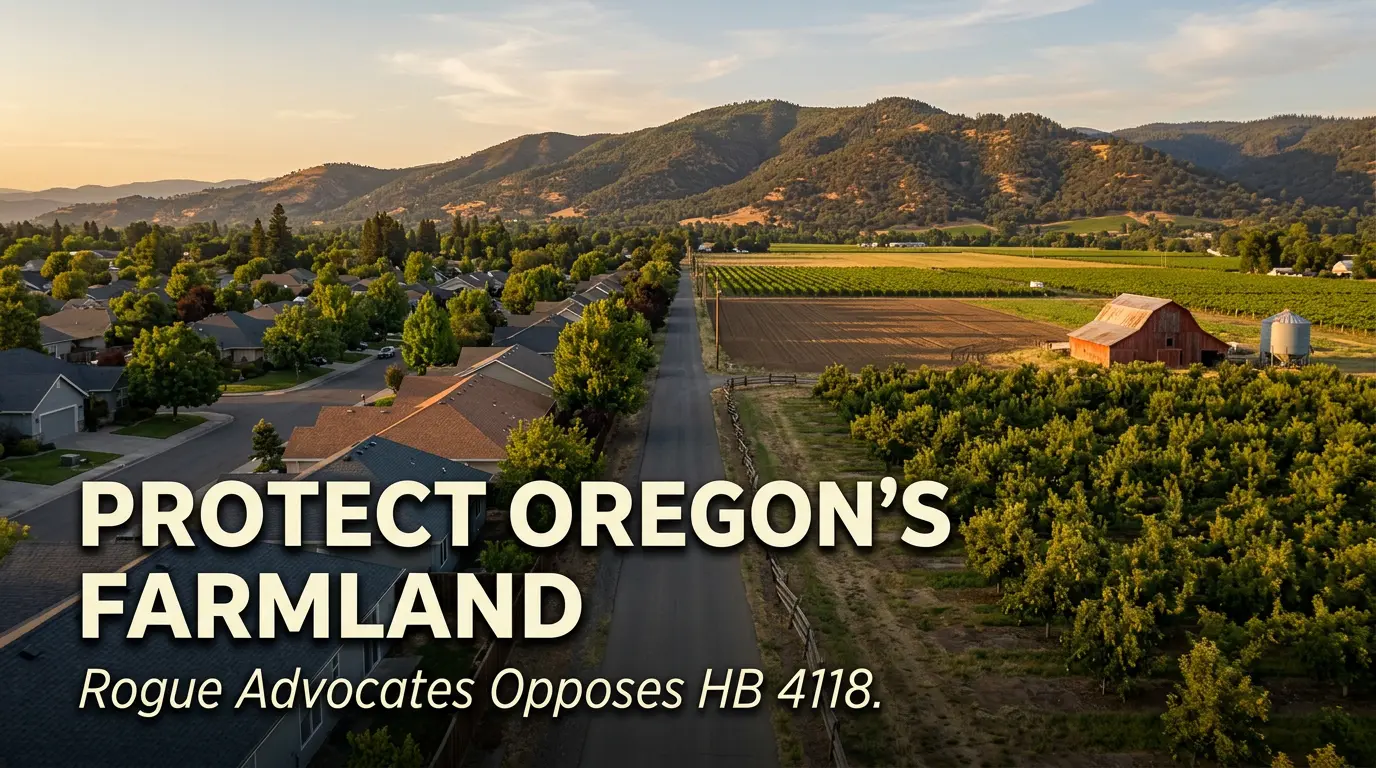
**2/14/22 UPDATE: The bill is dead after not passing out of Committee! Still check out the post below to learn about the types of threats our land use planning system faces.
HB 4118 bypasses Oregon’s land use planning processes and inappropriately pits farmland against affordable housing.
House Bill (HB) 4118 allows private landowners to request cities to expand its urban growth boundary (UGB) into a city’s urban reserve for “workforce housing” and “workforce commercial” uses without going through the land use planning process that requires public input and consideration of housing needs and other criteria intended to protect resource lands.
Urban reserves are areas outside of a city’s UGB designated to accommodate growth over the long-term range of 40-50 years, and only when it has been demonstrated that needs can no longer be met within the UGB. A city’s UGB is a boundary designating where a city can expand in order to meet anticipated growth over a 20 year time period. UGBs are intended to accommodate city growth while preventing urban sprawl and protecting farm and forest lands, and the process for amending a UGB reflects these values.
With Central Point, Eagle Point, Medford, Phoenix, Talent, and Grants Pass having designated urban reserve areas that contain thousands of acres of farm and forest land, HB 4118 directly implicates those lands. Because of historic development patterns nestling population centers among the best agricultural lands, the region requires thoughtful consideration with public input for expanding its UGBs, as was demonstrated by the nearly 13-year Bear Creek Regional Problem Solving process that identified urban reserve areas. Rogue Advocates opposes HB 4118 because it threatens this balance without proper consideration of when, and if, it is appropriate to incorporate these lands designated for long-term growth purposes into the city.
Additionally, Rogue Advocates opposes the -1 Amendment to HB 4118 replacing the terms of the bill with a task force on “Barriers to Housing, Industrial and Manufacturing Development” because it is too broad, has inadequate representation to successfully address the issues presented, and skews heavily towards stakeholders with interests in pushing development unrelated to addressing affordable housing (e.g. representatives from “the real estate industry”, “a building trade organization”, “the homebuilding industry”, “property owners seeking to develop property.”).
Read the full bill here and the -1 amendment here.
Rogue Advocates’ full testimony submitted to the legislature is below.
Rogue Advocates’ Testimony Opposing HB 4118
Related Stories
Defending Oregon’s Rural Heritage: Our Opposition to HB 2400, HB 2422, and HB 2316
Did you know Oregon has protected over 16 million acres of farmland since 1973? This shows our state’s dedication to keeping rural areas beautiful. But, three new bills – HB 2400, HB 2422, and HB 2316 – could change that. We strongly oppose these bills, fearing they could cause rural sprawl and harm our farming […]

An Opportunity to Support Rogue Valley from our Friends at Rogue Farm Corps!
Applications are OPEN for 2024Rogue Farm Corps Apprenticeships! Interested in exploring sustainable/regenerative farming and becoming part of the climate-smart agricultural movement? Earn a wage while you train with dedicated Host Farm mentors through a Rogue Farm Corps Apprenticeship! Apprentices learn and work at one of RFC’s partner Host Farms across the state of Oregon. This […]

We Need Your Help- Stop the Development of Oregon’s Protected Lands!
Rogue Advocates strongly supports the efforts of the Governor and Democratic Leadership to increase the affordability and accessibility of housing for all Oregonians statewide. However, we oppose the strategies laid out in Section 2 of HB 3414 which constitutes a major rollback of environmental protections in the state of Oregon. As it is currently written, […]